
Worse vs worst: Both words are correct, but worse compares one thing with another, while worst identifies the least favorable option or the most extreme degree. The difference comes down to comparative and superlative forms of bad. Here’s how to choose the right word, recognize common mistakes, and apply the same rule to other sentences.
The Short Answer
Use worse when something is more unpleasant, difficult, or inferior than something else. Use worst when describing the least favorable member of a group or the most extreme degree of a negative quality.
| Word | Meaning | Example |
|---|---|---|
| Worse | More unfavorable than another thing | Today’s weather is worse than yesterday’s. |
| Worst | The least favorable or most extreme | Today is the worst day of the week. |
The same distinction applies to adverbs: “She performed worse than expected” compares performance, while “She performed worst of all” identifies the lowest performance in a group.
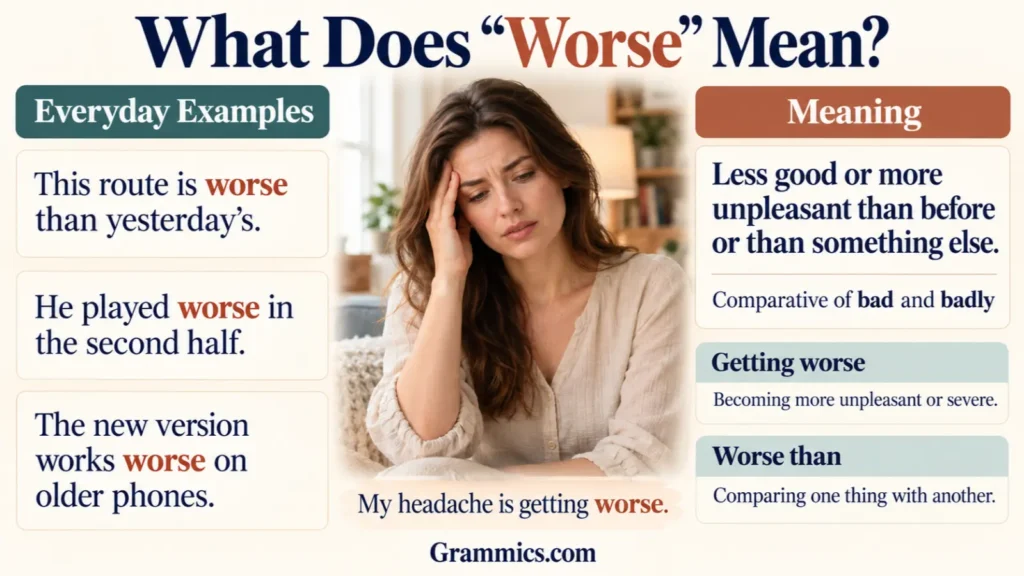
What “Worse” Means
Worse is the comparative form of the adjective bad and the adverb badly. It describes a decline, an unfavorable change, or a comparison between two things.
Examples:
- My headache is getting worse.
- This route is worse than the one we took yesterday.
- He played worse in the second half.
- The new version works worse on older phones.
The word doesn’t always require two things to be named. In “My headache is getting worse,” the comparison is between the current condition and an earlier one.
What “Worst” Means
Worst is the superlative form of bad and badly. It identifies the least favorable option in a group or the most extreme degree of a negative quality.
Examples:
- That was the worst meal I’ve ever had.
- Monday was the worst day of the trip.
- Of the three applicants, he performed worst.
- The northern roads were worst affected by the storm.
You’ll often see worst with the, as in “the worst mistake.” It can also appear without the in expressions such as “Worse vs worst of all” and “at worst.”
The Easy Test: Compare Two or Choose the Extreme
The simplest way to remember the distinction is to think of the three forms together:
Bad → Worse → Worst
- Bad: The original negative quality.
- Worse: A greater degree of that quality in comparison.
- Worst: The greatest degree of that quality within the relevant group or scale.
Consider these examples:
- “This laptop is worse than my old one.” You’re comparing two laptops.
- “This is the worst laptop I’ve owned.” You’re judging it against the broader group of laptops you’ve owned.
The number of items alone doesn’t decide the word. The comparison does. You can use worse to compare two options or describe a change over time. Use worst when you mean the lowest or most extreme point.
Where People Slip Up
“Worse Than” or “Worst Than”?
Use worse than for an ordinary comparison.
- Incorrect: This result is worst than the last one.
- Correct: This result is worse than the last one.
“Worst than” is not the standard comparative construction. Worst is already a superlative, so it normally appears in expressions such as “the worst result” or “the worst of the three.”
“Getting Worse” or “Getting Worst”?
The standard expression is getting worse because it describes a condition becoming more severe.
- Incorrect: The traffic is getting worst.
- Correct: The traffic is getting worse.
The same pattern appears in “things got worse,” “the situation became worse,” and “his condition worsened.” You don’t need worst simply because a situation has become very bad.
“The Worse” or “The Worst”?
Both can be correct, but they do different jobs.
- “Of the two choices, the worse one is more expensive.” Here, worse compares two choices.
- “Of all the choices, the worst one is more expensive.” Here, worst identifies the least favorable choice in the larger group.
The article the doesn’t automatically make worse incorrect. Look at what the sentence compares.
Common Expressions That Use Each Word
Some fixed expressions make the distinction easier to recognize.
| Expression | Meaning | Example |
|---|---|---|
| Get worse | Become more unfavorable | The weather may get worse tonight. |
| Turn for the worse | Begin to deteriorate | His condition took a turn for the worse. |
| Worst-case scenario | The most unfavorable possible outcome | In the worst-case scenario, we lose the deposit. |
| At worst | In the most unfavorable circumstances | The repair will take a week at worst. |
| Worst of all | The most serious or unpleasant item in a list | We missed the train and, worst of all, lost our tickets. |
| If worse comes to worst | If the situation reaches its most difficult point | If worse comes to worst, we’ll ask for help. |
Is It “Worse Case” or “Worst Case”?
Worst-case scenario is the standard expression when you mean the most unfavorable possible outcome. Before a noun, worst-case is hyphenated in this compound modifier: “a worst-case scenario.”
For example: “We should prepare for the worst-case scenario.”
Worse case can make sense in a different sentence when comparing one case with another: “This is a Worse vs worst case than the one we reviewed yesterday.” It isn’t the usual replacement for the established expression worst-case scenario.
“Worse Comes to Worse” or “Worst Comes to Worst”?
The established expression is if worse comes to worst. It describes a situation deteriorating from a bad state to the most unfavorable one. You’ll also encounter “if the worst comes to the worst,” particularly in British English.
For polished writing, use the familiar form that suits your audience and keep the wording consistent.
Examples in Real Sentences
These examples show how the comparative and superlative forms work in everyday writing:
- “My second interview went worse than my first one.” The sentence compares two interviews.
- “That was the worst interview of my career.” The sentence identifies an extreme experience.
- “The traffic is getting worse, so I’ll arrive late.” The situation is deteriorating.
- “Of the four proposals, this one is the worst.” One proposal ranks lowest in the group.
- “Her second attempt was worse, but her third was the worst.” The first comparison shows a decline; the second identifies the lowest point among the attempts.
- “The company expects conditions to worsen before they improve.” Worsen is the verb meaning “to become worse.”
Quick Self-Check
1. This restaurant is ___ than the one we visited last night.
Answer: Worse. The sentence compares two restaurants.
2. That was the ___ storm the town had experienced in decades.
Answer: Worst. The storm is identified as the most severe in the stated period.
3. My cold is getting ___.
Answer: Worse. The condition is deteriorating.
4. Of all five designs, this is the ___.
Answer: Worst. The design ranks at the bottom of the group.
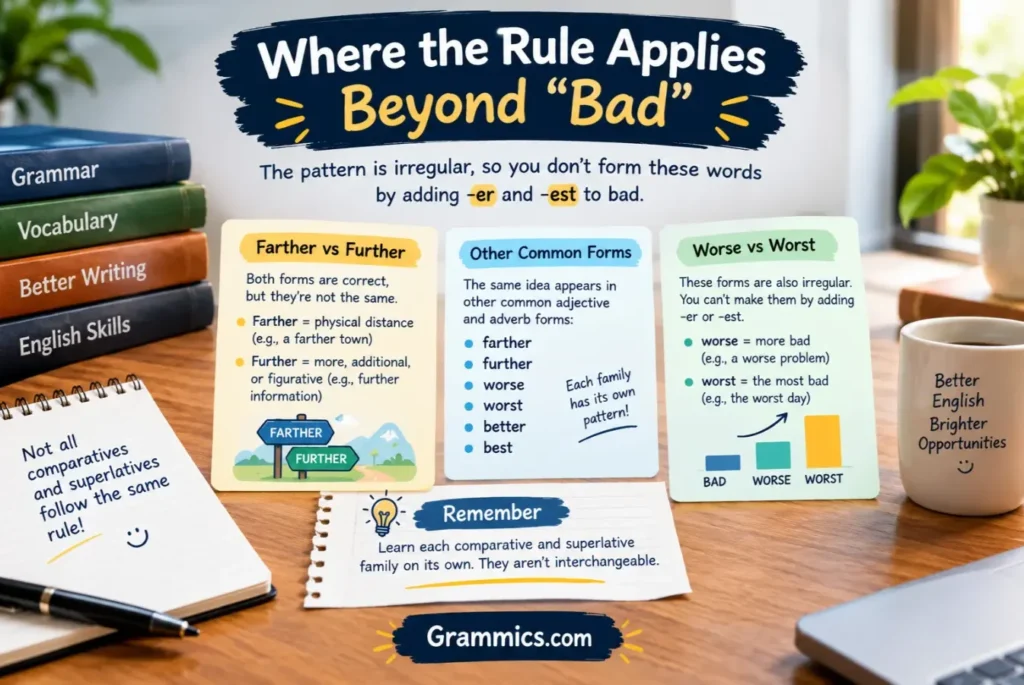
Where the Rule Applies Beyond “Bad”
The pattern is irregular, so you don’t form these words by adding -er and -est to bad.
The same idea appears in other common adjective and adverb forms:
| Base Form | Comparative | Superlative |
|---|---|---|
| Good | Better | Best |
| Bad | Worse | Worst |
| Well | Better | Best |
| Badly | Worse | Worst |
| Far | Farther or further | Farthest or furthest |
The forms farther and further have overlapping uses, and the preferred choice can depend on meaning and style. They aren’t interchangeable with Worse vs worst. Learn each comparative and superlative family on its own.
Final Thoughts
The difference between worse vs worst is grammatical, not a matter of spelling preference. Worse compares a thing with another or describes a decline; worst identifies the least favorable option or the most extreme degree. Remember bad, worse, worst, and check whether your sentence makes a comparison or identifies the bottom of a group.
For another useful grammar distinction, see our guide to affect vs. effect.
FAQs About “worse vs worst”
People use worst when they want to express the most extreme negative result, rather than a comparison with one other thing. For example, “That was the worst result” ranks it at the bottom of a group. In standard English, “That result was worse than mine” is the correct form for a direct comparison.
Worst means the least good, most unpleasant, most severe, or least favorable. It is the superlative form of bad and badly. For example, “This is the worst option” means no other option in the relevant group is considered as unfavorable.
In many American accents, worse is pronounced /wɝːs/ and worst is pronounced /wɝːst/. The key difference is the final /t/ sound in worst. British pronunciations vary by accent, but worst likewise has a final /t/ that worse does not.

Pingback: Liter or Litre: Difference, Usage & Examples
Pingback: Travelled or Traveled: Which Spelling Is Correct?