
Travelled or traveled are both correct spellings. Use travelled in British English and traveled in American English. The difference is a regional spelling convention, not a difference in meaning. If you’re writing for a British audience, use the double l; for an American audience, use the single l. This guide explains the rule and shows how the same pattern works in related words such as travelling/traveling and traveller/traveler.
The Short Answer
| Form | Status | Use It When |
|---|---|---|
| travelled | Correct | British English |
| traveled | Correct | American English |
| travelled | Common | Canadian English |
| traveled | Also used | Some Canadian English contexts |
So, is it travelled or traveled? Both work. Your choice depends on the variety of English you’re using.
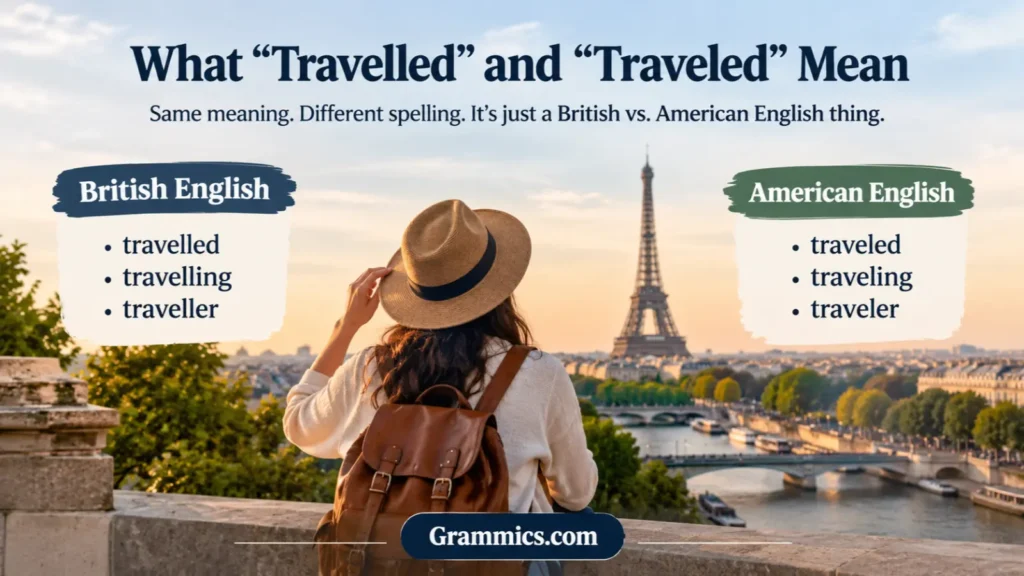
What “Travelled” and “Traveled” Mean
Travelled and traveled are the past tense and past participle forms of the verb travel. They mean to go from one place to another, usually over some distance.
She travelled to Paris last summer.
She traveled to Paris last summer.
The meaning doesn’t change. Only the spelling does. Cambridge lists traveled as the US spelling of travelled, while Oxford likewise gives the two forms as British and American variants.
The Rule Behind the Spelling
The main difference is how British and American English handle the final l in travel when adding endings such as -ed, -ing, and -er.
British English normally doubles the l:
- travel → travelled
- travel → travelling
- travel → traveller
American English normally keeps one l:
- travel → traveled
- travel → traveling
- travel → traveler
Oxford’s style guide explicitly lists travelling/traveling, travelled/traveled, and traveller/traveler as British–American spelling differences.
Why Does “Travel” Behave This Way?
There’s a useful spelling rule behind many doubled-consonant forms, but travel doesn’t behave exactly the same way in British and American English.
In American English, the final l usually isn’t doubled in these forms because the stress in travel falls on the first syllable.
British English traditionally doubles the l in this word:
travel → travelled
So don’t treat travelled as an incorrect version of traveled. It’s the standard British form.
Other Words That Follow the Same Pattern
The same regional spelling pattern appears in several related words.
| British English | American English |
|---|---|
| travelled | traveled |
| travelling | traveling |
| traveller | traveler |
| cancelled | canceled |
| labelled | labeled |
| levelled | leveled |
The important pattern is simple: British spelling often keeps the doubled l, while American spelling commonly uses a single l in these forms.
Why Both Spellings Exist
Travelled or traveled spelling differs because British and American English developed different conventions for certain words ending in l.
This isn’t a case of one spelling becoming “correct” and the other becoming “incorrect.” Dictionaries recognize both forms and identify them by regional usage.
That’s why you’ll see:
- British: “I have travelled extensively.”
- American: “I have traveled extensively.”
Which Spelling Should You Use?
If You’re Writing in British English
Choose travelled.
We travelled around Scotland for two weeks.
This is also the spelling you’ll normally want in British-style writing alongside travelling and traveller.
If You’re Writing in American English
Choose traveled.
We traveled around California for two weeks.
American English normally uses traveling and traveler as the related forms.
What About Canadian English?
Canadian English can show variation, but travelled and travelling are commonly used. Oxford’s American dictionary specifically notes that Canadian English usually uses travelled and travelling in these forms.
Examples in Real Sentences
Here are natural examples of travelled or traveled in context:
I travelled to London for a business meeting.
I traveled to New York for a business meeting.
She has travelled extensively throughout Europe.
He has traveled across several US states.
We travelled by train because it was more convenient.
They traveled for three days before reaching their destination.
None of these sentences changes meaning because of the spelling. The difference is regional.
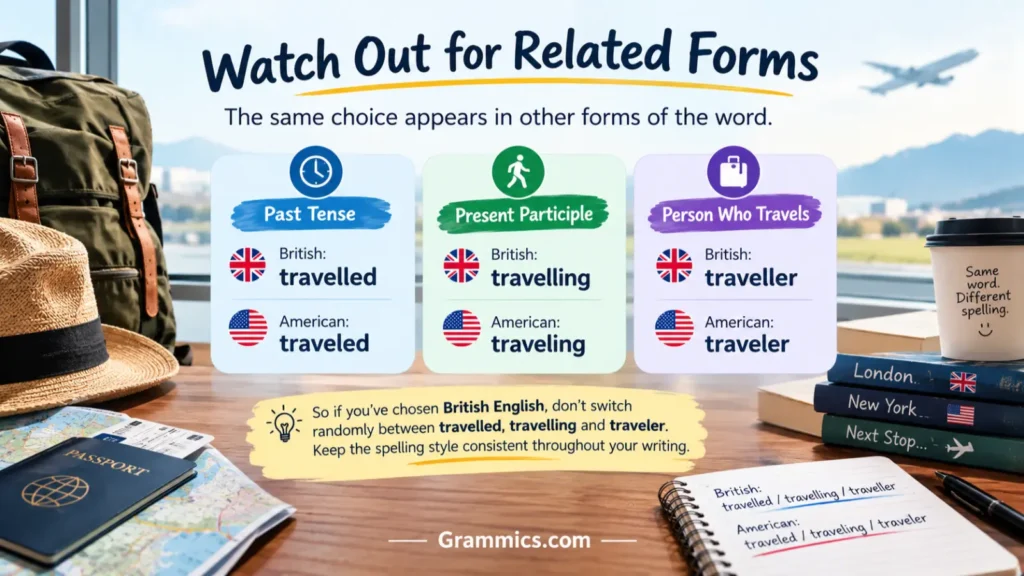
Watch Out for Related Forms
The same choice appears in other forms of the word.
Past Tense
British: travelled
American: traveled
Present Participle
British: travelling
American: traveling
Person Who Travels
British: traveller
American: traveler
So if you’ve chosen British English, don’t switch randomly between travelled, traveling, and traveler. Keep the spelling style consistent throughout your writing.
Quick Self-Check
Which form fits each sentence?
1. She ___ to Italy last year.
✓ travelled — if the sentence uses British English.
2. He ___ across the country for work.
✓ traveled — if the sentence uses American English.
3. They are ___ through Europe this summer.
✓ travelling in British English; traveling in American English.
Final Thoughts
Travelled or traveled are both correct. Use travelled in British English and generally in Canadian English, while traveled is the standard American form. The same regional pattern appears in travelling/traveling and traveller/traveler. Pick the variety that matches your audience and stick with it.
For another useful spelling comparison, see our guide to cancelled vs canceled.
FAQs
Both are correct. Travelled is the standard British spelling, while traveled is the standard American spelling. They are different regional forms of the same past-tense and past-participle verb. The choice doesn’t change the meaning, so use the spelling that matches the variety of English you’re writing in.
In the UK, travelled is the standard spelling. British English normally also uses travelling and traveller. American English generally uses traveled, traveling, and traveler instead.
Travelled is commonly used in Canadian English, although Canadian spelling can show variation. If you’re writing for a Canadian audience, travelled is a natural choice. Oxford notes that Canadian English usually uses travelled and travelling.
No. Travelled isn’t a misspelling. It’s the British form. However, traveled is the usual choice for standard American English, so use the single l when following US spelling conventions.
No. Traveled is the American spelling of the word. It may look unusual in British English, where travelled is standard, but that doesn’t make it an incorrect English word.
Explore More Grammar Guides:
Hilight or Highlight: Which Is Correct and Where to Use It
Liter vs. Litre: Differences, Examples, and When to Use Each
Worse vs Worst: Which Is Correct? The Rule Explained
