
Both liter and litre are correct spellings of the same metric unit of volume. Liter is the standard American English spelling, while litre is preferred in British English, Canadian English, and Australian English. The difference is regional, not a difference in meaning or measurement. If you’re writing for a US audience, use liter; if you’re following British or Canadian conventions, use litre.
The Short Answer: Liter or Litre?
The answer to liter or litre which is correct depends on the English variety you’re using. Both words describe the same metric unit, and neither spelling is inherently incorrect.
| Spelling | Where It’s Preferred | Example |
|---|---|---|
| Liter | American English | One liter of water |
| Litre | British English | One litre of water |
| Litre | Canadian English | Two litres of milk |
| Litre | Australian English | A five-litre container |
For an American audience, choose liter and liters. For British readers, use litre and litres. Canadian and Australian English generally prefer litre as well.
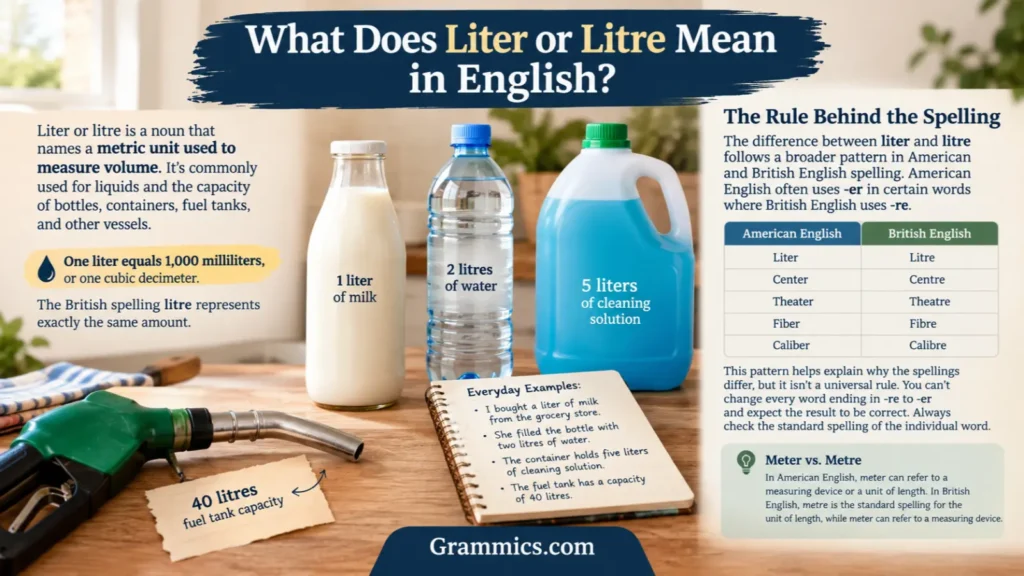
What Does Liter or Litre Mean in English?
The word liter or litre is a noun that names a metric unit used to measure volume. It’s commonly used for liquids and the capacity of bottles, containers, fuel tanks, and other vessels.
One liter equals 1,000 milliliters, or one cubic decimeter. The British spelling litre represents exactly the same amount.
Examples:
- I bought a liter of milk from the grocery store.
- She filled the bottle with two litres of water.
- The container holds five liters of cleaning solution.
- The fuel tank has a capacity of 40 litres.
The quantity doesn’t change when the spelling changes. A liter and a litre are equal in volume.
The Rule Behind the Spelling
The difference between liter and litre follows a broader pattern in American and British English spelling. American English often uses -er in certain words where British English uses -re.
| American English | British English |
|---|---|
| Liter | Litre |
| Center | Centre |
| Theater | Theatre |
| Fiber | Fibre |
| Caliber | Calibre |
This pattern helps explain why the spellings differ, but it isn’t a universal rule. You can’t change every word ending in -re to -er and expect the result to be correct. Always check the standard spelling of the individual word.
One related distinction is meter vs. metre. In American English, meter can refer to a measuring device or a unit of length. In British English, metre is the standard spelling for the unit of length, while meter can refer to a measuring device.
Liter vs. Litre: American and British Usage
When deciding is it liter or litre, consider your target audience and the type of document you’re writing.
American English: Use liter in school assignments, business writing, recipes, product descriptions, and website content intended for US readers.
Example: The recipe requires two liters of water.
British English: Use litre when following standard British spelling conventions.
Example: Please pour two litres of water into the mixture.
Canadian English: Litre is the preferred Canadian spelling. If you’re writing for a Canadian audience, use litre and litres unless a particular publication specifies another convention.
Australian English: Litre is the standard spelling in Australian usage.
The practical rule is simple: choose the spelling that suits your English variety and remain consistent throughout the document.
How to Write the Plural: Liters or Litres?
The plural depends on the regional spelling you choose. Both forms follow the ordinary English rule for forming the plural of a countable measurement unit.
| Quantity | American English | British English |
|---|---|---|
| One | 1 liter | 1 litre |
| Two | 2 liters | 2 litres |
| Five | 5 liters | 5 litres |
| Ten | 10 liters | 10 litres |
For example, 1 liter or 1 litre is correct for a single unit. For a quantity greater than one, write 2 liters in American English or 2 litres in British English.
When writing the unit symbol, use L for either spelling. Unit symbols don’t take a plural ending, so write 5 L, not 5 Ls. Leave a space between the number and the symbol.
Examples of Liter and Litre in Real Sentences
These examples show how to use both spellings naturally in everyday writing and professional communication.
American English examples
- I bought a liter of milk for breakfast.
- The water bottle holds two liters.
- The recipe requires half a liter of cream.
- The car’s fuel tank holds 50 liters.
British English examples
- Please pour one litre of water into the jug.
- The container holds three litres of paint.
- The instructions recommend adding two litres of water.
- The shop sells a five-litre bottle of cleaning solution.
Each sentence uses the spelling associated with its regional English convention. The meaning and volume remain the same.
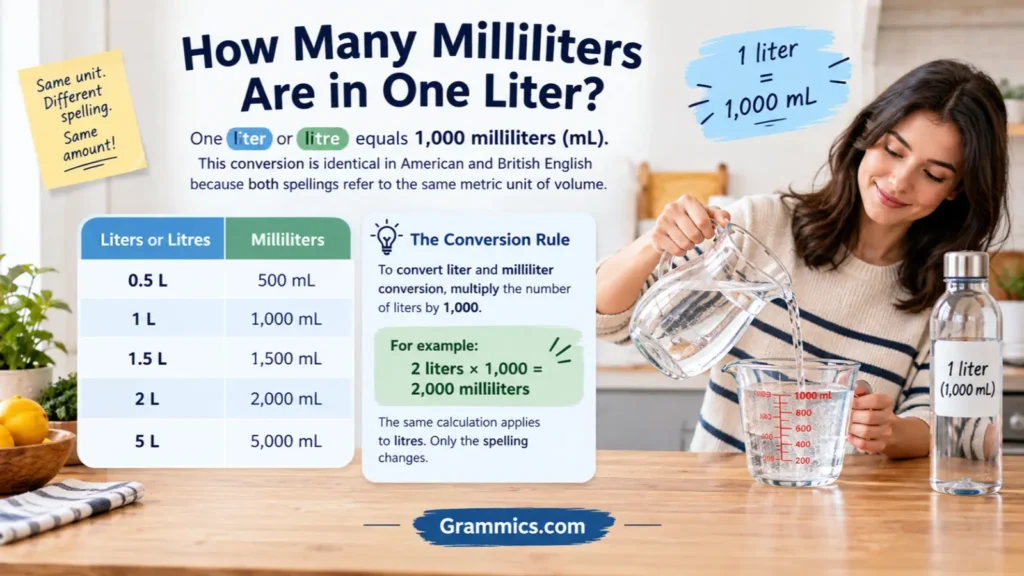
How Many Milliliters Are in One Liter?
One liter or litre equals 1,000 milliliters (mL). This conversion is identical in American and British English because both spellings refer to the same metric unit of volume.
| Liters or Litres | Milliliters |
|---|---|
| 0.5 L | 500 mL |
| 1 L | 1,000 mL |
| 1.5 L | 1,500 mL |
| 2 L | 2,000 mL |
| 5 L | 5,000 mL |
To convert liter and milliliter conversion, multiply the number of liters by 1,000.
For example:
2 liters × 1,000 = 2,000 milliliters
The same calculation applies to litres. Only the spelling changes, not the mathematical conversion.
How Do You Pronounce Liter and Litre?
The words liter and litre name the same measurement and have corresponding pronunciations in their respective English varieties. Their spelling difference doesn’t indicate a difference in meaning or volume.
American speakers generally pronounce liter with the vowel and ending typical of American English. British pronunciation varies by accent, so there isn’t one single pronunciation used by every British speaker.
If you’re learning English, listen to speakers from the variety you’re studying and consult a reputable dictionary with audio pronunciation to hear the difference.
Final Thoughts
The choice between liter or litre comes down to regional spelling conventions. Use liter and liters for American English, and litre and litres for British and Canadian English. Australian English also generally uses litre. Remember the -er/-re spelling pattern, but don’t apply it blindly to every word. For measurements, use the symbol L without adding a plural s.
FAQs
In standard British English, 2 litres is the usual written form because the quantity is greater than one. In American English, write 2 liters. Both are correct within their respective regional spelling conventions. In technical writing, you can also use 2 L, where the unit symbol remains unchanged regardless of the quantity.
Americans call them liters and use the American spelling liter. The measurement is exactly the same as a British litre. The difference is simply how the word is written, not the size of the unit or the way it is converted to milliliters.
Yes. Litre is the preferred Canadian spelling of the metric unit of volume. Canadian English generally follows litre and litres, while American English uses liter and liters. If you’re writing for a Canadian audience, litre is the appropriate default spelling.
Litre is the standard spelling in Australian English. The American form liter is recognizable but doesn’t follow the usual Australian spelling convention. For Australian schoolwork, general writing, and locally targeted website content, use litre and litres consistently.
Explore More Grammar Guides:
Hilight or Highlight: Which Is Correct and Where to Use It
Worse vs Worst: Which Is Correct? The Rule Explained

Pingback: Travelled or Traveled: Which Spelling Is Correct?