
A corn is a thickened area of skin caused by repeated friction or pressure, while a wart is a skin growth caused by human papillomavirus (HPV). If you’re trying to identify a hard bump on your foot, its texture, location, and response to pressure can offer useful clues. However, these conditions can look remarkably similar, particularly on the sole. Understanding the differences can help you avoid unsuitable treatments and recognize when you need a professional diagnosis.
The Short Answer: Corn vs. Wart
Corns and warts aren’t the same condition, even though both can produce small, hard areas of skin. The main difference is what causes them: repeated pressure creates a corn, whereas an HPV infection causes a wart.
| Feature | Corn | Wart |
|---|---|---|
| Main cause | Friction and pressure | HPV infection |
| Typical appearance | Thickened skin with a firm central core | Rough, raised, or thickened skin growth |
| Skin lines | May remain visible across the area | May be interrupted by the growth |
| Dark dots | Not a typical defining feature | May contain tiny dark or reddish dots |
| Pain | Often tender under direct pressure | May hurt with walking or side-to-side pressure |
| Contagious? | No | Yes, warts can spread through contact |
These features are clues, not a definitive test. A plantar wart can grow beneath thickened skin, making it difficult to distinguish from a corn or callus without an examination.
What Is a Corn?
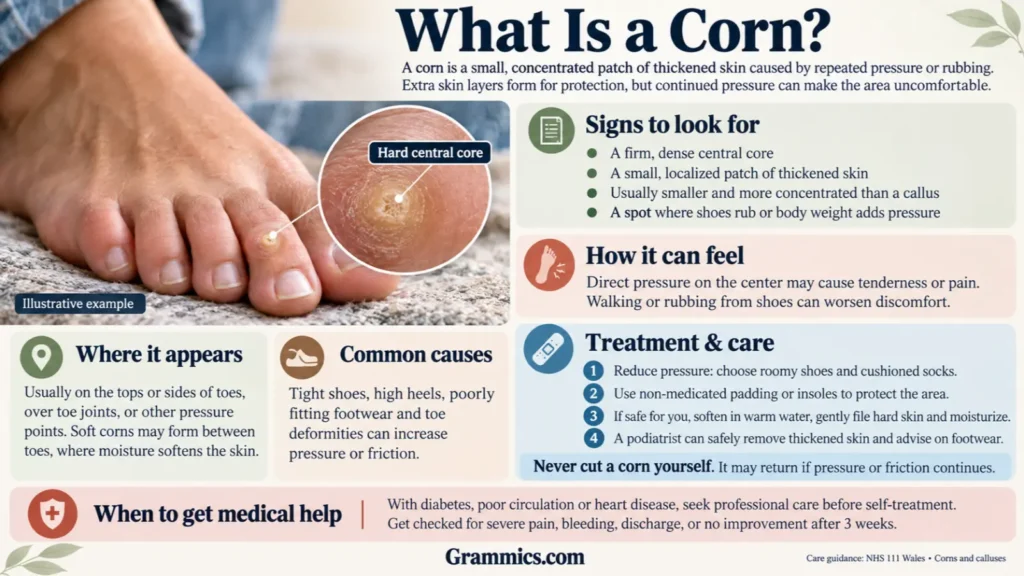
A corn is a small, concentrated area of thickened skin that develops in response to repeated pressure or rubbing. Your skin builds up extra layers as a protective response, but the hardened area can become uncomfortable when pressure continues.
Corns commonly appear on the tops or sides of toes, over toe joints, and in other places where footwear repeatedly rubs the skin. Soft corns may develop between toes, where moisture makes the skin softer.
Common Signs of a Corn
- A firm center: A corn often has a dense central core surrounded by thickened skin.
- A localized patch: It is usually smaller and more concentrated than a typical callus.
- Pressure-related tenderness: Direct pressure on the center may cause discomfort.
- A predictable location: It often develops where shoes rub or body weight places repeated pressure on the foot.
Tight shoes, high heels, poorly fitting footwear, and toe deformities can contribute to corn formation. A corn may return if the source of friction or pressure remains.
What Is a Wart?
A wart is a noncancerous skin growth caused by certain types of human papillomavirus. The virus enters through small breaks in the skin and causes skin cells to grow differently, producing a visible growth.
Warts can develop on the hands, fingers, knees, and other parts of the body. A wart that develops on the sole of the foot is called a plantar wart. Because walking places pressure on the sole, a plantar wart can grow inward beneath thickened skin instead of forming an obvious raised bump.
Common Signs of a Wart
- A rough or uneven surface: Some warts have a grainy texture, although others appear relatively smooth.
- Tiny dark dots: These may represent small blood vessels within the growth.
- Interrupted skin lines: The natural lines on the skin may stop or change around the wart.
- One or several growths: Warts can occur individually or in groups.
- Possible tenderness: Plantar warts can hurt when walking or when the affected area is compressed.
Not every wart has dark dots or an obviously rough surface. Likewise, a wart’s appearance can change when thick skin covers it. Don’t assume that a growth is harmless simply because it resembles a typical wart.
How to Tell Whether a Bump Is a Corn or a Plantar Wart
If you’re examining a hard spot on the bottom of your foot, compare several features rather than relying on one visual clue.
1. Examine the Surface
A corn usually looks like compact, thickened skin with a firm center. A plantar wart may have an irregular surface, tiny dark dots, or a pattern that differs from the surrounding skin.
However, thick skin can cover a wart and make it look almost identical to a corn. Surface appearance alone is not enough to confirm the diagnosis.
2. Consider Where It Appears
Location provides useful context.
A corn is more likely when a hard patch develops over a toe joint, between toes, or at a point where footwear repeatedly rubs. A plantar wart is possible when a growth appears on the heel or ball of the foot.
Neither location proves what the growth is. Both conditions can occur in areas that experience pressure.
3. Notice How It Responds to Pressure
Corns often hurt when you press directly down on their central core. Plantar warts can be painful when squeezed from the sides or compressed during walking.
This distinction is sometimes used during a clinical examination, but it is not reliable enough to diagnose yourself. Both conditions can hurt under direct pressure, and some cause little or no pain.
4. Look for Changes in the Skin Lines
The natural lines on the sole of your foot may continue across a corn. A plantar wart may interrupt these lines.
This can be a useful visual clue, especially when considered alongside the surface and location. Still, thickened skin, lighting, and the size of the growth can make the pattern difficult to interpret.
The safest approach: If the growth is uncertain, have a healthcare professional examine it instead of cutting, scraping, or treating it based on appearance alone.
Is a Corn or a Wart More Painful?
Neither condition is always more painful. The amount of discomfort depends on the growth’s location, size, depth, and the pressure placed on it.
A corn may hurt when a shoe presses against a toe or when you walk on a hard central core. A plantar wart may cause discomfort on the heel or ball of the foot because these areas bear much of your body weight.
Pain also varies between individuals. Some warts cause no symptoms, while others become tender, itchy, or irritated. A painful growth should not automatically be classified as a corn or wart.
If the pain interferes with walking, becomes severe, or continues despite reducing pressure, arrange a medical assessment.
What Do Pictures of Corns and Plantar Warts Show?
Pictures can help you understand the typical appearance of each condition, but they cannot reliably identify the cause of a growth on your own foot.
When reviewing plantar wart or corn pictures, pay attention to the overall pattern rather than one detail.
- Corn pictures: Look for a small, well-defined area of thickened skin, often with a firm central core.
- Plantar wart pictures: Look for a rough or rounded growth, sometimes with tiny dark dots or disrupted skin lines.
- Callus pictures: Look for a broader patch of thickened skin rather than a small, concentrated lesion.
Real examples vary. A plantar wart may be covered by a thick layer of skin, and a corn may look rough or irregular. Online images should therefore be used for general comparison, not as a substitute for diagnosis.
Can You Treat a Corn Like a Wart?
No. You should not automatically use wart treatment on a suspected corn, or corn-removal products on a growth that might be a wart.
Some treatments contain salicylic acid, which removes layers of skin, but the product, strength, and application method depend on the condition. These products can also irritate healthy skin or cause injury when used incorrectly.
How Corns Are Usually Managed
For a confirmed corn, the main goal is to reduce the pressure or friction that caused it.
Helpful measures may include:
- Wearing shoes with enough room for your toes.
- Using suitable protective padding to reduce rubbing.
- Choosing footwear that doesn’t repeatedly press against the affected area.
- Seeking professional care if the corn remains painful or keeps returning.
A healthcare professional may carefully remove some of the hardened skin or recommend footwear changes and inserts when appropriate. Never cut a corn out yourself.
How Plantar Warts Are Usually Treated
Some plantar warts disappear without treatment, although this can take months or longer. When treatment is needed, options may include salicylic acid products or freezing performed by a healthcare professional.
Treatment depends on the growth, its location, and your medical history. Warts can also spread to other areas or people, so avoid picking at them and follow appropriate hygiene advice.
If you are unsure whether the growth is a wart, seek a diagnosis before applying a wart-removal product.
Who Should Avoid Self-Treatment?
People with diabetes, poor circulation, reduced sensation in their feet, or a weakened immune system should seek medical advice before attempting to remove a corn or wart themselves.
Even a small injury can cause complications in people with certain underlying conditions. Avoid sharp tools, aggressive filing, and medicated removal products unless a qualified healthcare professional has confirmed that the treatment is suitable.
What If the Growth Is on a Finger or Toe?
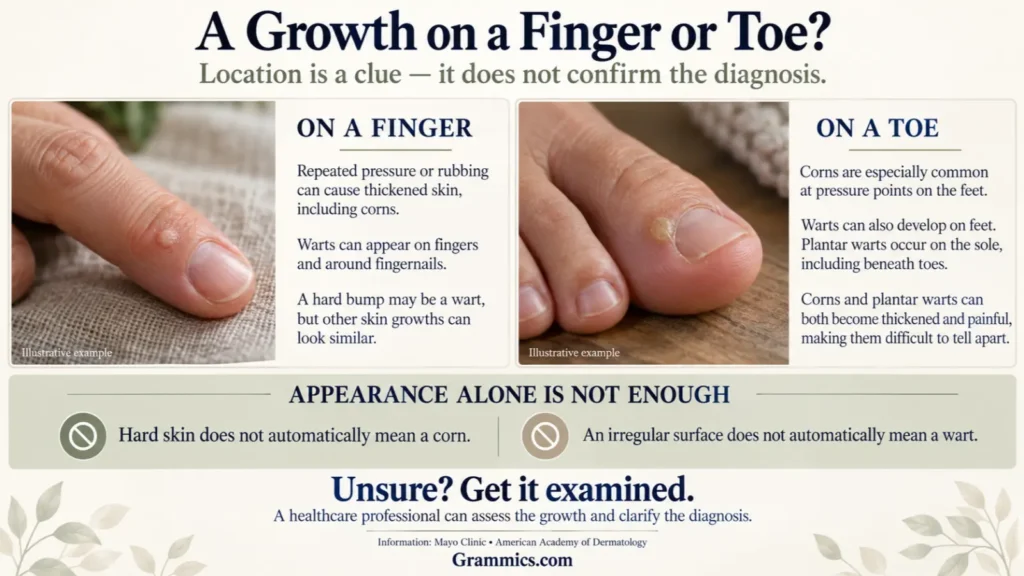
Corns can develop on toes and fingers where repeated pressure or rubbing affects the skin, although they are particularly associated with pressure points on the feet. Warts can also appear on fingers, around fingernails, and on the feet.
A hard bump on a finger may be a wart, but other skin growths can look similar. On a toe, the distinction can be especially difficult because both corns and plantar warts can become thickened and painful.
Do not assume that a bump is a corn simply because it is hard, or a wart because it has an irregular surface. A professional examination is the best way to resolve uncertainty.
When Should You See a Healthcare Professional?
Arrange an assessment if you cannot identify the growth, if it is unusually painful, or if home care has not helped. Seek prompt medical advice if it bleeds, changes in appearance, grows rapidly, becomes an open sore, or shows signs of infection.
A clinician can examine the skin and consider other possible causes, including cysts and growths that may resemble warts. In some cases, additional testing or a biopsy may be necessary.
Do not delay assessment of an unusual or changing growth simply because it looks like a common corn or wart.
Final Thoughts
A corn develops when repeated pressure or friction thickens the skin, while a wart develops because of an HPV infection. Surface texture, location, skin lines, and pain can help you compare the two, but none of these signs guarantees a diagnosis. If you’re still asking, “is it a corn or a wart,” have a healthcare professional examine the growth before trying removal products or cutting the skin.
FAQs
Yes, a plantar wart can look like a corn because both cause thickened skin on the foot. Tiny black dots and disrupted skin lines may indicate a wart, while a hard central core may suggest a corn.
A corn usually develops from repeated pressure or friction, while a plantar wart may have tiny black dots and interrupt the skin’s natural lines. Since their appearance can overlap, a healthcare professional can confirm the cause.
No, corn and wart treatments aren’t always interchangeable because the two conditions have different causes. Avoid self-treatment if you have diabetes, poor circulation, or reduced foot sensation, and seek medical advice.
No, a plantar wart is caused by human papillomavirus (HPV), while a corn develops because of repeated pressure or friction. Both can cause foot pain, but they may require different treatments.
No, corns aren’t contagious because they result from pressure or friction, but warts can spread through contact with infected skin or contaminated surfaces. Avoid picking at warts and keep your feet clean to reduce the risk of spreading them.
