
Good Morning Everyone is correct as a greeting, but “Good morning, everyone” is the standard form when you’re directly addressing a group. The comma separates the greeting from the people being addressed, just as it does in “Hello, everyone.”
If you’re writing an email, posting a message, or looking for a natural morning greeting, the difference is mostly about punctuation, tone, and context. Here’s the rule, the meaning, examples, alternatives, and the difference between everyone and everybody.
The Short Answer
“Good morning, everyone” is the best choice when you are speaking directly to a group.
The comma marks everyone as a direct address. Without the comma, “Good morning everyone” is common in casual digital writing, but it is less polished in edited prose. Cambridge notes that vocatives words used to address someone directly are commonly separated with commas.
| Form | Status | Use It When |
|---|---|---|
| Good morning, everyone. | Standard | Directly greeting a group |
| Good morning everyone. | Common informal style | Casual texts, chats, or posts |
| Good morning, everybody. | Standard | Directly greeting a group |
| Good morning! | Standard | A shorter general greeting |
What “Good Morning Everyone” Means
Good morning is a greeting used during the morning, while everyone means every person in a particular group. Merriam-Webster defines everyone as “every person” and lists everybody as a synonym.
So, the phrase simply means that you are wishing or giving a sunrise greeting to all the people present or included in the conversation.
For example:
Good morning, everyone! I hope you’re ready for the meeting.
The phrase can sound friendly, professional, cheerful, or neutral depending on what follows it.
The Comma Rule Behind the Greeting
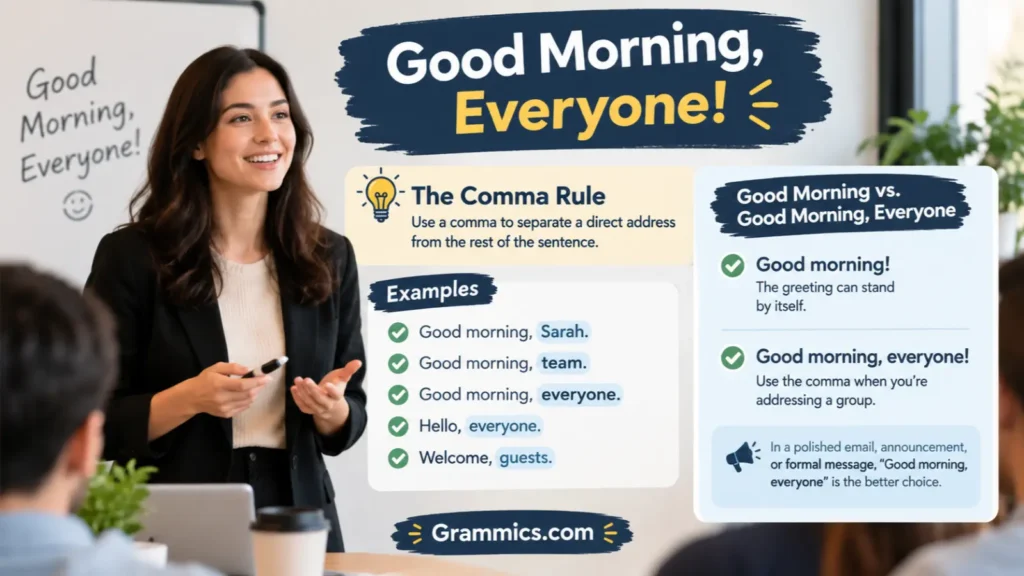
The key rule is simple: use a comma to separate a direct address from the rest of the sentence.
In “Good morning, everyone,” the word everyone tells us who is being addressed. It isn’t part of the grammatical structure of the greeting itself. That’s why the comma belongs between sunrise and everyone.
The same pattern works with names:
- Good morning, Sarah.
- Good morning, team.
- Good morning, everyone.
- Hello, everyone.
- Welcome, guests.
The comma isn’t optional simply because you don’t hear a dramatic pause while speaking. In writing, punctuation helps show the relationship between the greeting and the person or group being addressed.
“Good Morning” vs. “Good Morning, Everyone”
There’s an important distinction between the greeting and the person being addressed.
Good morning can stand by itself:
Good morning!
When you add the group you’re speaking to, use the comma:
Good morning, everyone!
That same rule explains why “Good morning, everyone” is preferable in a polished email, announcement, or formal message.
Everyone or Everybody: What’s the Difference?
Everyone and everybody have the same basic meaning: they refer to all the people in a group. Cambridge classifies both as indefinite pronouns and notes that they are written as single words.
So, good greeting everyone or everybody is not really a question of right versus wrong.
Both are grammatical:
Good morning, everyone!
Good morning, everybody!
Everyone often feels slightly more neutral and is a particularly easy choice for workplace or school writing. Everybody can sound a little more conversational, but neither is inherently informal or incorrect.
You can also use every one in a different construction. For example, “I thanked every one of them” means each individual person, whereas everyone means all people as a group.
Why People Leave Out the Comma
The version “Good morning everyone” is easy to produce because people often write the way they speak. In quick texts, social posts, chats, and captions, punctuation is frequently reduced or omitted.
There’s also no obvious visual difference in speech. You hear the greeting as one short expression, so the comma isn’t something you can hear as clearly as you can see it.
That doesn’t make the unpunctuated version meaningless. It simply makes it less formally edited.
If you’re writing something where punctuation matters, use:
Good morning, everyone.
If you’re sending a quick group chat message, Good morning everyone! will still be understood.
Examples in Real Sentences
Here are natural examples across different situations.
Email:
Good morning, everyone. I’ve attached the updated schedule for today’s meeting.
Work meeting:
Good morning, everyone. Let’s get started.
Classroom:
Good morning, everyone! Please take your seats.
Group chat:
Good morning everyone! Hope you all slept well.
Social post:
Good morning, everyone! Wishing you a peaceful start to the day.
Announcement:
Good morning, everyone. We’ll begin the event at 9 a.m.
Notice that the comma stays when everyone is the group being addressed.
How to Use the Greeting in an Email
For a good morning everyone email, the polished version is:
Good morning, everyone,
if the greeting is followed by the body of the email on the same line or as part of the opening salutation.
You can also write:
Good morning, everyone.
I’m writing to confirm tomorrow’s schedule.
For workplace communication, this is clearer and more conventional than leaving the comma out.
If you’re addressing a smaller group, you can replace everyone with the group’s name:
Good morning, team.
Good morning, colleagues.
Good morning, everyone.
The choice depends on how formal and personal you want the opening to sound.
Other Ways to Say Good Morning
You don’t need to use the same greeting every day. The best alternative depends on the setting and your relationship with the audience.
Rise and shine, everyone! — cheerful and playful.
Good morning, team! — friendly and useful at work.
Morning, everyone! — shorter and casual.
Wishing everyone a wonderful morning. — warm and polished.
Hope everyone has a great morning. — conversational.
Hello, everyone, and good morning. — slightly more formal and welcoming.
A very good morning to you all. — formal or intentionally traditional.
Top of the morning to you all. — playful and old-fashioned; it isn’t necessary for ordinary workplace communication.
These alternatives are more useful than simply replacing every word with an artificial synonym. A greeting should sound like something a real person would actually say.
Good Morning Everyone in Different Languages
The phrase is also commonly searched as a translation. Here are straightforward equivalents:
- Spanish: Buenos días a todos.
- French: Bonjour à tous.
- German: Guten Morgen, alle zusammen.
- Japanese: 皆さん、おはようございます。 (Minasan, ohayō gozaimasu.)
If you’re specifically searching for how to say good morning everyone in German, Guten Morgen, alle zusammen is a natural group greeting.
The exact wording can vary by language because greetings don’t always map word-for-word from English.
Good Morning Everyone: Images, GIFs, and Memes
A greeting doesn’t always have to be plain text. Good morning everyone images are popular for social posts, status updates, and group messages, especially when the image includes flowers, coffee, sunrise scenery, or an inspirational message.
For something more animated, a good morning everyone gif can add movement without requiring a long message. A good morning everyone gif funny is better suited to friends or informal group chats than professional communication.
Likewise, a good morning everyone meme can turn an ordinary greeting into a joke.
You can also tailor the message to the day:
Good morning, everyone! Happy Wednesday!
That works well with good morning everyone happy wednesday images.
For the end of the workweek:
Good morning, everyone! Happy Friday!
A good morning everyone happy friday gif can make that message more playful.
Funny and Playful Versions
If the audience is made up of friends, coworkers you know well, or a social-media audience, you can make the greeting less formal.
Try:
Good morning, everyone! Coffee first, questions later.
Or:
Good morning, everyone! May your coffee be strong and your meetings be short.
A deliberately sarcastic version can work too:
Good morning to everyone except the person who scheduled this meeting at 8 a.m.
That style is behind searches such as good morning to everyone except and good morning to everyone except the person who made this. The joke works because it turns a friendly group greeting into a mock complaint.
Keep these versions out of formal business emails unless you already know the audience will appreciate the joke.
Good Morning Everyone Quotes and Messages
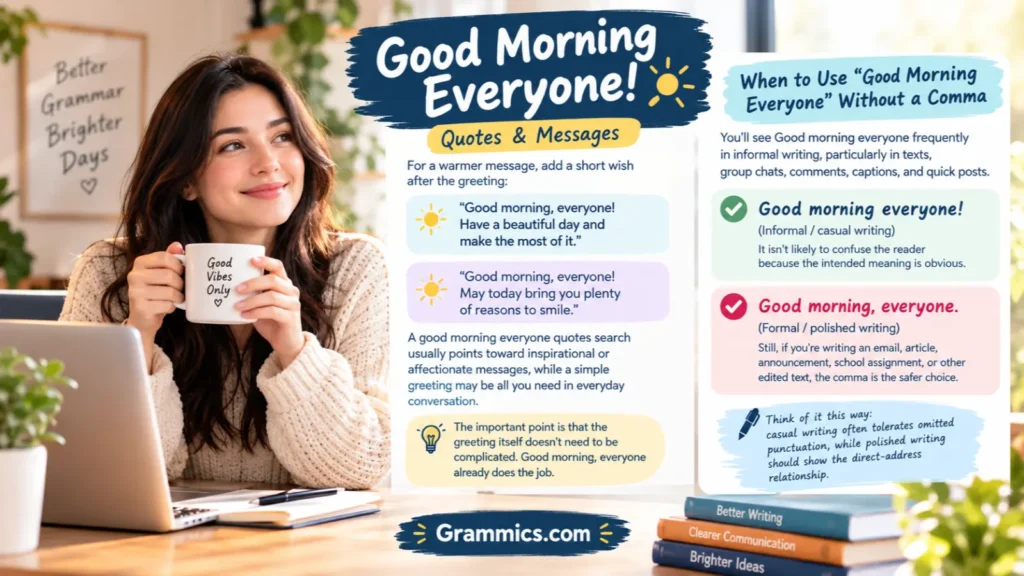
For a warmer message, add a short wish after the greeting:
Good morning, everyone! Have a beautiful day and make the most of it.
Or:
Good morning, everyone! May today bring you plenty of reasons to smile.
A good morning everyone quotes search usually points toward inspirational or affectionate messages, while a simple greeting may be all you need in everyday conversation.
The important point is that the greeting itself doesn’t need to be complicated. Good morning, everyone already does the job.
When to Use “Good Morning Everyone” Without a Comma
You’ll see Good morning everyone frequently in informal writing, particularly in texts, group chats, comments, captions, and quick posts.
It isn’t likely to confuse the reader because the intended meaning is obvious.
Still, if you’re writing an email, article, announcement, school assignment, or other edited text, the comma is the safer choice:
Good morning, everyone.
Think of it this way: casual writing often tolerates omitted punctuation, while polished writing should show the direct-address relationship clearly.
Quick Self-Check
1. Choose the polished version:
“Good morning everyone, welcome to the workshop.”
Answer: Good morning, everyone. Welcome to the workshop. The comma marks everyone as direct address.
2. Which sounds correct in a professional email?
“Good morning, everybody.” or “Good morning everybody.”
Answer: Good morning, everybody. The same direct-address comma rule applies to everybody.
3. Is everyone written as one word?
Answer: Yes. Everyone is one word when it means every person. Every one is a separate construction used in expressions such as “every one of them.”
Final Thoughts
Good Morning Everyone is a correct phrase, but “Good morning, everyone” is the standard polished form when you’re addressing a group directly. The comma separates the greeting from the people being addressed.
Use everyone for a neutral, natural greeting and everybody when you prefer a slightly more conversational sound. For more useful wording choices, see related guidance on professional email phrases.
FAQs About Good Morning Everyone
It means “good morning to all the people in the group.” It’s a friendly greeting used when addressing several people at once. In standard written English, the polished form is “Good morning, everyone,” because everyone functions as a direct address.
Yes. The phrase is grammatically understandable and widely used, especially in informal writing. However, if you’re asking for the most carefully punctuated version, write “Good morning, everyone.” The comma identifies everyone as the group being addressed rather than as part of the greeting itself.
You can, but “Good morning, everyone” is the better choice for a polished work email. It follows the standard comma convention for direct address and gives the opening a cleaner appearance. For a formal audience, punctuation like this is worth getting right because the greeting sets the tone for the message.
It can work in both settings, but the level of formality comes from the surrounding wording. “Good morning, everyone” is suitable for meetings, classrooms, announcements, and many professional emails. A version with a joke, meme, or playful wording is better reserved for informal conversations.
Neither is grammatically superior. Everyone and everybody both mean every person, so the choice is mainly about tone and preference. Everyone is a neutral, versatile choice, while everybody can feel a little more conversational. Both take the same comma in direct address.
Explore More Grammar Guides:
Good Afternoon: Meaning, Timing, Examples, and Greetings
TBH What Does It Mean? Meaning, Uses, and Examples
ASL Meaning in Text: What Does ASL Mean in Slang?
