
Good afternoon is a polite greeting used when you meet someone during the afternoon. The phrase normally fits the period after 12 p.m. and before evening, although the exact boundary can depend on the situation. Cambridge defines midday as the part of the day beginning around twelve and ending around six or sunset, while Oxford describes good afternoon as a polite way to say hello in the salutation.
If you’re wondering about good afternoon time, capitalization, formal situations, or what to say instead, here’s the practical answer.
What Does Good Afternoon Mean?
Good afternoon is a polite way to greet someone after midday. It can be used when meeting a person face-to-face, starting a conversation, answering someone, or opening a speech, meeting, email, or announcement.
For example:
Good afternoon, everyone. Thank you for joining us.
It can sound more formal than hi or hello, which makes it particularly useful in workplaces, classrooms, customer service, meetings, and public speaking.
Oxford also notes that good afternoon can sometimes be used formally when people leave each other in the midday.
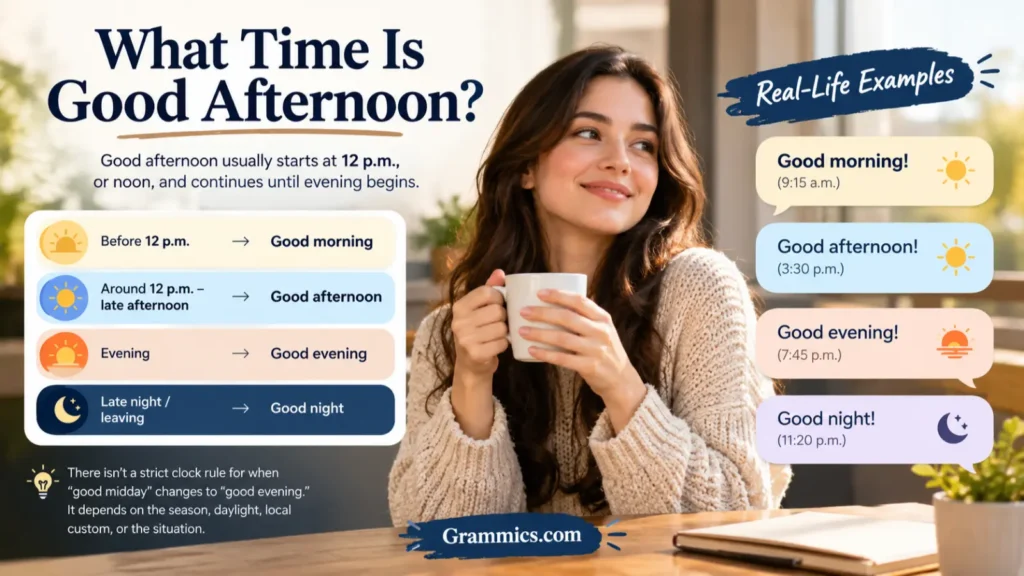
What Time Is Good Afternoon?
The usual good afternoon time starts at 12 p.m., or noon. It generally continues through the well wishes until evening begins.
There isn’t a universal clock rule that says exactly when good midday must change to good evening. In ordinary conversation, people use the time of day as a guide rather than watching the clock.
A useful rule is:
| Time | Natural Greeting |
|---|---|
| Before 12 p.m. | Good morning |
| Around 12 p.m.–late afternoon | Good afternoon |
| Evening | Good evening |
| Late night / leaving | Good night |
So, 3:30 p.m. is clearly midday, making good expression a natural greeting.
The transition into evening is more flexible. It may depend on the season, daylight, local custom, or the type of situation. Cambridge places the casual at roughly noon through six o’clock or sunset.
Do You Say Good Afternoon After 12 PM?
Yes. Good afternoon is appropriate after noon.
If you meet someone at 12:15 p.m., 2 p.m., or 4 p.m., saying good afternoon is perfectly natural.
For example:
- Good afternoon, Mr. Wilson.
- Good greetings, everyone.
- Good afternoon, Sarah. How are you?
- Good casual, Professor Lee.
You don’t need to wait until a particular well wishes hour. Noon marks the practical starting point.
Correct Capitalization and Writing Rules
In an ordinary sentence, capitalize Good when the greeting begins the sentence, but keep afternoon lowercase.
Correct:
Good afternoon, everyone.
Also correct:
She said, “Good afternoon, Tom.”
Not normally:
Good Afternoon, everyone.
The second version isn’t appropriate as ordinary sentence capitalization. You may see Good Afternoon in titles, posters, headings, designs, or graphics because title-style capitalization follows different conventions.
The important point is simple: midday is normally a lowercase common noun.
Good Afternoon as a Formal Greeting
Good afternoon works especially well when you want to sound polite, respectful, or professional.
You can use it with:
- A teacher
- A manager
- A customer
- A client
- A colleague
- An interviewer
- A group
- An audience
- Someone you have just met
For example:
Good afternoon, Ms. Carter. Thank you for meeting with me.
In a presentation:
Good afternoon, ladies and gentlemen. Today, I’d like to discuss our new project.
In customer service:
Good afternoon. How may I help you?
It isn’t exclusively formal, though. You can also say it to a friend or neighbor. The tone simply tends to be more polite than a quick hi or hey.
Good Afternoon in Texts and Messages
You can absolutely use good afternoon in a text message.
The choice depends on your relationship with the person.
Formal:
Good afternoon, I wanted to confirm our meeting for 3 p.m.
Friendly:
Good afternoon! Hope you’re having a great day.
Warm:
Good afternoon, beautiful! Hope your day is going well.
Casual:
Afternoon! How’s everything going?
Oxford lists salutation by itself as an informal shortened form of good afternoon.
Polite and Friendly Alternatives
You don’t have to repeat the same greeting every time. The best alternative depends on the relationship and situation.
Professional Alternatives
- Hello
- Good day
- I hope you’re having a good afternoon
- I hope your afternoon is going well
- Good greeting, everyone
- Hello, everyone
For an email, Hello is often a safer neutral choice because the recipient may read the message at a different time.
Friendly Alternatives
- Hi!
- Hey!
- Midday!
- Hope you’re having a great afternoon
- Enjoy your daily works
- Have a great casual
Warm or Personal Alternatives
If you’re writing to someone close to you, you might use:
- Good greetings, beautiful
- Good afternoon, my friend
- Hope you’re having a lovely midday
- Wishing you a peaceful afternoon
- Have a wonderful salutation
The supplied competitor pages focus heavily on alternative greetings, but a useful distinction is missing from many list-style articles: an alternative isn’t automatically a synonym. Hello, for example, can work at many times of day, while good afternoon specifically identifies the midday.
Good Afternoon Wishes and Blessings
A greeting can also become a wish when you add a positive message.
Examples include:
Good afternoon! Wishing you a peaceful and productive day.
Good afternoon! May the rest of your day be filled with happiness.
Good afternoon! Sending warm wishes your way.
This explains searches such as good greeting blessings, good midday quotes, and good casual wishes.
For visual greetings, people may also search for good salutation images, good well wishes gif, or good greeting blessings images to send through messaging apps or social platforms.
These expressions aren’t grammar rules. They’re different ways people extend the basic greeting.
Good Afternoon in Different Languages
The phrase changes naturally from one language to another.
| Language | Translation |
|---|---|
| Spanish | buenas tardes |
| Italian | buon pomeriggio |
| French | bonjour / bon après-midi |
| German | guten Tag |
| Portuguese | boa tarde |
| Japanese | こんにちは |
| Russian | добрый день |
| Greek | καλό απόγευμα |
| Chinese | 下午好 |
If you’re specifically searching for good afternoon in Spanish, the usual greeting is buenas tardes. Cambridge gives buenas tardes as the Spanish translation.
So how to say good casual in Spanish and how do you say good midday in Spanish have the same basic answer: buenas tardes.
The natural translation isn’t always a literal word-for-word conversion. Greeting conventions differ between languages, so the phrase people actually use matters more than translating each English word separately.
How to Use This Greeting in Everyday Sentences
These some examples of good afteroon:
Hello, everyone. Let’s begin today’s meeting.
Good afternoon, Mrs. Brown. Your appointment is at three.
I walked into the office and greeted everyone politely.
Hope you’re having a lovely day!
Hello, Professor. I have a question about the assignment.
She smiled and greeted David warmly.
Welcome, everyone, to today’s presentation.
He sent me a message saying, “Hi! How are you?”
The greeting may change depending on the situation, but the aim remains the same: to sound polite, friendly, and appropriate.
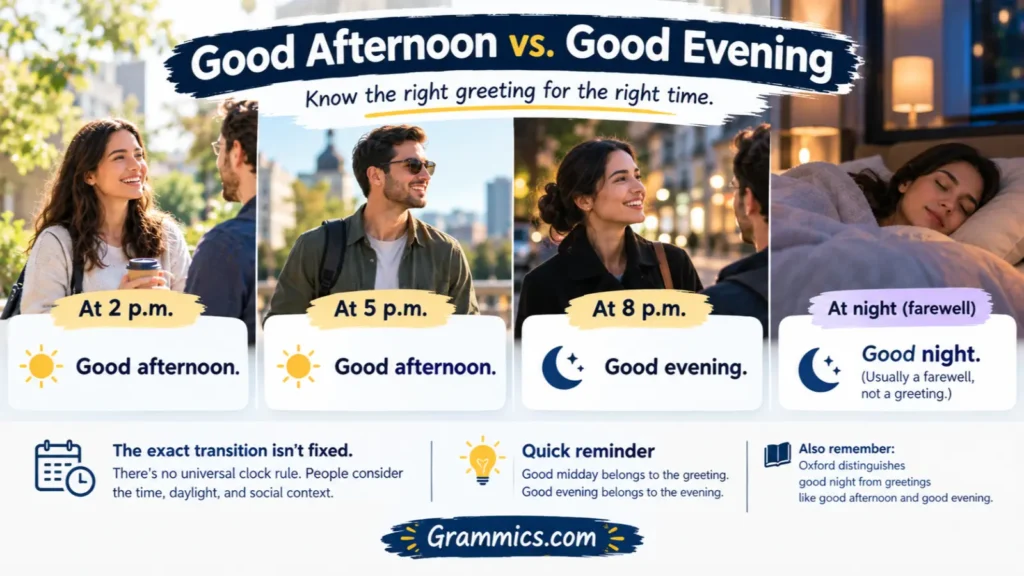
Good Afternoon vs. Good Evening
The tricky part isn’t the spelling. It’s knowing when to switch greetings.
Good midday belongs to the greeting. Good evening belongs to the evening.
At 2 p.m.:
Good afternoon.
5 p.m.:
Good afternoon.
At 8 p.m.:
Good evening.
The exact transition isn’t fixed by a universal clock rule. In everyday English, people consider the time, daylight, and social context.
Also remember that good night is normally a farewell, not the standard greeting you use when meeting someone. Oxford specifically distinguishes good night from greetings such as good casual and good evening.
When This Greeting Isn’t Appropriate
Don’t use good afternoon simply because it sounds polite. The time still matters.
If it’s 9 a.m., say good morning.
If it’s clearly evening, good evening is more natural.
And if you’re writing an email that could be opened at any time, hello can be more practical than a time-specific greeting.
For example, instead of:
Good afternoon, I am writing to ask about the position.
you could write:
Hello, I am writing to ask about the position.
That avoids making the greeting dependent on when the recipient reads the email.
Quick Self-Check
1. You meet your teacher at 2 p.m. What do you say?
Good afternoon. That’s the standard polite wishes greeting.
2. You meet a colleague at 10 a.m. Can you say good salutation?
No. Good morning is the natural greeting because it is still morning.
3. Which is normally correct in a sentence: “Good Afternoon” or “Good afternoon”?
Good casual. Only the first word is normally capitalized when the phrase begins a sentence.
4. Is 3:30 p.m. midday?
Yes. It falls comfortably within the casual.
Final Thoughts
Good afternoon is a polite and natural greeting used from around noon through the greeting. Use it when you meet someone, begin a conversation, start an email, or address a group during this part of the day. Remember that greeting etiquette is normally lowercase unless it appears in a title or heading. For a warmer message, you can also use good afternoon wishes, blessings, or a simple have a great salutation.
FAQs
Good afternoon means a polite hello used when meeting someone during the midday. It can sound formal or simply courteous, depending on the situation. You can use it with friends, colleagues, teachers, customers, clients, or groups. The phrase can also be used formally when parting during the salutation.
Good afternoon is generally more polite and formal than hi or hey, but it isn’t restricted to formal situations. You can use it with friends as well. The surrounding words determine much of the tone: “Good greeting etiquette, sir” sounds formal, while “Good midday! How’s your day going?” can sound friendly.
Yes. Afternoon can be used as an informal shortened greeting. Oxford specifically lists it as an informal short form of good casual. It works best in relaxed conversations rather than formal introductions, presentations, or professional situations.
It can be. Good afternoon is primarily a greeting, but Oxford notes that it can sometimes be used formally when people leave each other in the midday. In ordinary social conversation, phrases such as have a good greeting or enjoy your salutation are more clearly farewell expressions.
Yes. Good midday is perfectly acceptable at the beginning of an email when you know the recipient will receive or read it in the lovely. If the reading time is uncertain, Hello or another neutral greeting may be more practical. In a formal email, you can write, “Good midday, Ms. Smith,” followed by a comma.
Explore More Grammar Guides:
Define SMH: Meaning in Text, Slang & Real Examples
TBH What Does It Mean? Meaning, Uses, and Examples
What Is WTM in Text? Meanings, Examples, and Replies
