
SMH means “shaking my head.” To define smh simply, it’s an informal texting and internet abbreviation people use to show disbelief, disappointment, annoyance, disapproval, or sometimes playful amusement. Cambridge Dictionary defines SMH as an abbreviation for “shaking my head” used in texts and social media when someone doesn’t believe or approve of something.
If someone texts, “You forgot your wallet again, smh,” they’re not literally describing a head movement. They’re expressing a reaction to what happened.
What Does SMH Mean?
Define SMH stands for “shaking my head.” It represents the reaction someone might physically make when they see something ridiculous, frustrating, disappointing, or difficult to believe.
For example:
“You seriously spent all your money on that? SMH.”
The writer probably means, “I can’t believe you did that.”
The abbreviation can carry different shades of emotion. It may communicate mild frustration, disbelief, disappointment, criticism, or playful teasing. The surrounding message usually tells you which one is intended.
So, if you search define smh in text, the answer is generally “shaking my head.”
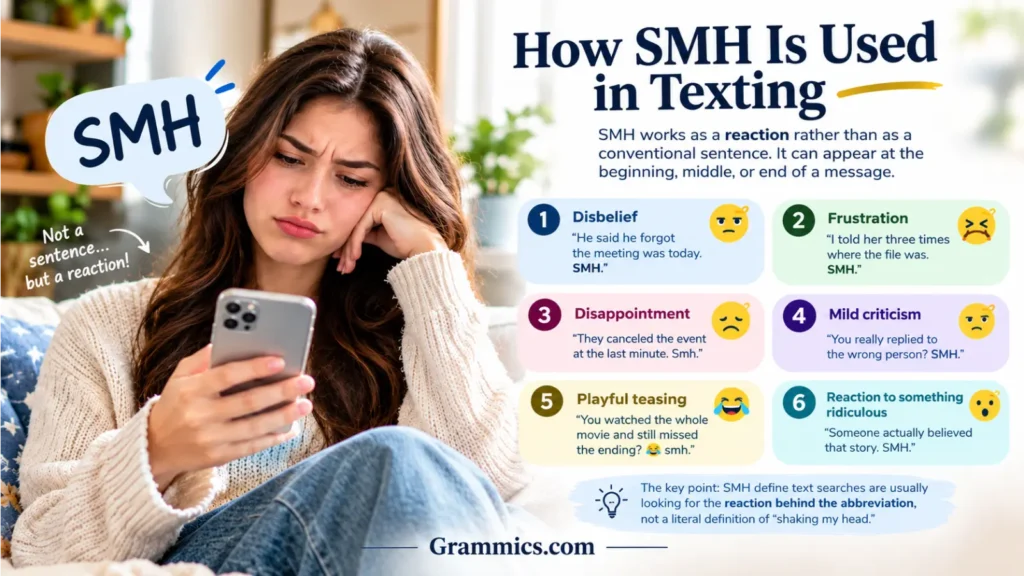
How SMH Is Used in Texting
SMH works as a reaction rather than as a conventional sentence. It can appear at the beginning, middle, or end of a message.
1. Disbelief
“He said he forgot the meeting was today. SMH.”
Here, SMH shows that the situation is hard to believe.
2. Frustration
“I told her three times where the file was. SMH.”
The abbreviation adds a feeling of irritation.
3. Disappointment
“They canceled the event at the last minute. Smh.”
The writer is expressing disappointment with the decision.
4. Mild criticism
“You really replied to the wrong person? SMH.”
This can sound critical without being extremely harsh.
5. Playful teasing
“You watched the whole movie and still missed the ending? 😂 smh.”
Here, SMH is probably humorous rather than genuinely angry.
6. Reaction to something ridiculous
“Someone actually believed that story. SMH.”
The abbreviation signals disbelief or disapproval.
The key point is that SMH define text searches are usually looking for the reaction behind the abbreviation, not a literal definition of “shaking.”
What Does SMH Stand For?
The letters in SMH come directly from the phrase “shaking my head.”
The phrase describes a familiar gesture: moving your head from side to side to express disagreement, disbelief, sadness, or that you don’t believe something.
Online, SMH turns that physical reaction into three letters.
You might see:
- “smh”
- “SMH”
- “smh…”
- “smh lol”
- “SMH 😂”
Capitalization usually doesn’t change the meaning. People often type internet abbreviations in lowercase simply because casual messages don’t require capitalization.
What Tone Does SMH Have?
The meaning of SMH stays basically the same, but its tone can change with context.
Disbelief
“SMH, I can’t believe he said that.”
The writer is surprised and finds the situation difficult to believe.
Frustration
“My internet stopped working again. SMH.”
The writer is annoyed by the situation.
Disapproval
“They knew the rules and still ignored them. SMH.”
Here, the abbreviation communicates criticism.
Disappointment
“You promised you’d be there. SMH.”
This sounds more serious because the surrounding sentence expresses personal disappointment.
Playful Teasing
“You put ketchup on everything? SMH 😂”
The abbreviation can soften into a joke when paired with a laughing emoji or obviously harmless situation.
That’s why define smh slang doesn’t have a single emotional translation such as “angry.” The exact feeling depends on what happened and how the message is written.
Is SMH Rude or Disrespectful?
SMH isn’t automatically rude, but it can sound dismissive or disrespectful.
If a close friend sends “smh 😂,” you may understand it as playful teasing. If someone replies “SMH” to a serious explanation, however, it can feel like they’re judging or dismissing you.
Compare these:
“You forgot your charger again 😂 smh.”
This sounds lighthearted.
“SMH. That’s your excuse?”
This sounds much more critical.
The relationship between the people matters, too. Friends may use SMH casually, while the same abbreviation from a stranger, teacher, customer, or coworker could sound unnecessarily dismissive.
If you’re unsure about the tone, don’t assume SMH means the person is angry. Read the complete message and consider the conversation around it.
What Does SMH Mean From a Friend?
When a friend sends SMH, it often means something like:
“I can’t believe you.”
It may be serious, but it is frequently playful.
For example:
“You drove all the way to the store and forgot what you went there for? SMH 😂”
Your friend is probably teasing you.
But:
“SMH. You knew that would hurt me.”
has a more serious tone.
The abbreviation itself doesn’t tell you whether the person is joking or genuinely annoyed. The words around it do.
How to Respond to “SMH”
Your response should match the tone of the original message.
If it’s clearly playful, you can joke back:
“What? It seemed like a good idea 😂”
“When You’ve Actually Made a Mistake, a Simple Acknowledgment Works”
“Okay, fair. My bad.”
If the person sounds genuinely frustrated, respond to the issue instead of joking about the abbreviation:
“I understand why you’re annoyed. I should’ve told you earlier.”
You don’t need to respond to SMH as though it were a question. It’s usually a reaction, so your reply should address the situation that caused the reaction.
Where You’ll See SMH
SMH is primarily associated with informal digital communication. Cambridge specifically identifies its use in social media and text messages.
You may encounter it in:
- Text messages
- WhatsApp chats
- Snapchat messages
- TikTok comments
- Facebook posts and comments
- Instagram captions or comments
- Online forums
- Gaming chats
- Casual group conversations
The abbreviation works especially well where short reactions are common.
For example, someone might comment:
“He really posted that publicly? SMH.”
Or write:
“SMH, I just locked myself out again.”
The reader is expected to understand SMH as an emotional reaction.
Is SMH Formal or Informal?
SMH is informal.
It’s appropriate for casual conversations where abbreviations and internet slang are expected. It’s generally not appropriate for formal business correspondence, academic papers, official applications, or professional reports.
Instead of writing:
“SMH, the customer missed the deadline again.”
in a professional email, write:
“The customer missed the deadline again, which is disappointing.”
That version communicates the same basic reaction without relying on slang.
This distinction matters because someone unfamiliar with internet abbreviations may not understand SMH at all.
SMH on Different Social Platforms
The meaning doesn’t fundamentally change from one platform to another.
SMH on WhatsApp
In WhatsApp chats, SMH usually means “shaking my head.” A friend might send it after hearing something surprising or frustrating.
SMH on Snapchat
On Snapchat, SMH can be used as a short reaction to a snap, message, or story.
SMH on TikTok
TikTok users may put SMH in comments or captions to react to something they find unbelievable, ridiculous, annoying, or disappointing.
SMH on Facebook
On Facebook, SMH can appear in comments or posts as a reaction to someone’s statement or an event.
The platform changes, but the basic meaning remains the same.
Can SMH Be Positive?
Usually, SMH expresses a negative or critical reaction, but it isn’t necessarily hostile.
A person can use it jokingly in a positive or harmless interaction:
“SMH, you’re too competitive 😂”
The speaker isn’t necessarily angry. They’re playfully reacting to someone’s behavior.
So smh define questions shouldn’t treat the abbreviation as a synonym for “anger.” Its core idea is a head-shaking reaction, while the exact emotion comes from context.
What Does “SMH LOL” Mean?
“SMH LOL” combines two informal reactions.
SMH means “shaking my head,” while LOL means “laughing out loud.”
Together, they can show that the writer finds a situation ridiculous or amusing even while criticizing it.
For example:
“You actually forgot your own birthday? SMH LOL.”
The message is probably teasing rather than seriously angry.
The combination of abbreviations and emojis often helps readers understand the intended tone.
Is There a “Dirty” Meaning of SMH?
In ordinary texting and social media, SMH means “shaking my head.” It is not normally a sexual or dirty abbreviation.
If you encounter an unusual meaning in a specific online community, the surrounding conversation should determine what the writer intended. Don’t assume an uncommon interpretation when the standard meaning fits naturally.
SMH vs. Similar Texting Expressions
| Term | Meaning | Typical Tone |
|---|---|---|
| SMH | Shaking my head | Disbelief, disapproval, frustration |
| LOL | Laughing out loud | Amusement |
| OMG | Oh my God | Surprise or excitement |
| WTF | What the fuck | Strong surprise, anger, or disbelief |
| IDK | I don’t know | Uncertainty or lack of knowledge |
| IKR | I know, right? | Agreement or shared reaction |
SMH is distinctive because it communicates a reaction of disbelief or disapproval rather than simply surprise or laughter.
For example, “OMG!” can show surprise, while “SMH” suggests that the person thinks something is ridiculous, disappointing, or hard to believe.
Common Examples of SMH in Conversation
Here are a few natural examples that show how the abbreviation works:
“You left your phone at home again? SMH.”
This expresses mild frustration.
“SMH, he didn’t read a single instruction.”
This shows disbelief or disapproval.
“You really thought that was the answer? 😂 SMH.”
This is playful teasing.
“They promised to fix it last week. SMH.”
This communicates disappointment.
“SMH, I just sent the email to the wrong person.”
Here, the writer is criticizing their own mistake.
Notice that SMH doesn’t provide the main information in any of these messages. It adds the writer’s reaction to the information.
When Should You Use SMH?
Use SMH when you’re communicating casually with people who understand internet slang.
It’s useful when a full sentence such as “I can’t believe this” feels unnecessarily long.
For example:
“You bought another pair of shoes? SMH 😂”
is natural in a casual chat.
But if you’re writing to a professor, employer, client, or official organization, spell out the reaction instead.
The simplest rule is: SMH belongs in casual communication, not formal writing.
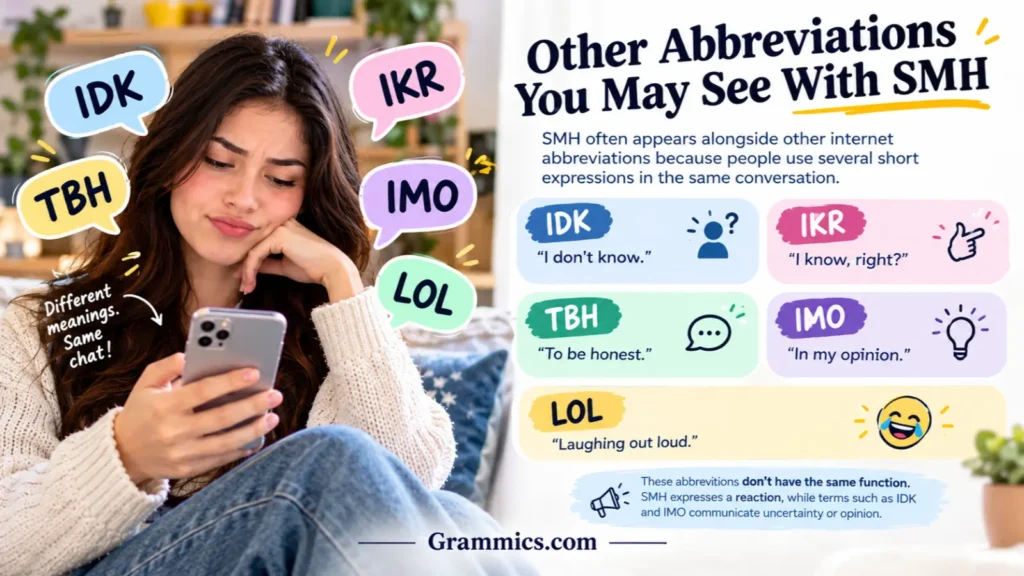
Other Abbreviations You May See With SMH
SMH often appears alongside other internet abbreviations because people use several short expressions in the same conversation.
IDK means “I don’t know.”
IKR means “I know, right?”
TBH means “to be honest.”
IMO means “in my opinion.”
LOL means “laughing out loud.”
These abbreviations don’t have the same function. SMH expresses a reaction, while terms such as IDK and IMO communicate uncertainty or opinion.
Final Thoughts
SMH means “shaking my head.” It’s an informal abbreviation used in texts, chats, and social media to express disbelief, frustration, disappointment, disapproval, or playful teasing. The exact tone depends on the context, so define smh as a reaction rather than simply a synonym for anger. Use it casually, not in formal or professional writing.
FAQs: About SMH Mean
SMH stands for “shaking my head.” People use it online as a quick reaction to something unbelievable, frustrating, disappointing, or ridiculous.
Yes, SMH is informal internet and texting slang. It’s common in casual messages and social media but usually doesn’t belong in formal emails, academic writing, or professional communication.
Not necessarily. SMH can sound playful between friends, but it may feel dismissive or critical in a serious conversation, so context matters.
There’s no special meaning when a girl says SMH. She normally means “shaking my head,” with the tone ranging from playful teasing to genuine frustration depending on the conversation.
SMH usually expresses disbelief or disapproval rather than positivity. However, friends may use it jokingly, especially with laughing emojis, without intending any serious criticism.
Explore More Grammar Guides:
What Does WSG Mean in Text? Meaning, Examples & Replies
WYA Meaning in Text: What It Means and How to Reply
What Is WTM in Text? Meanings, Examples, and Replies
